There were plenty of women at the forefront of the French Revolution – some stormed the Bastille, others like Olympe de Gouges used their words to express their grievances. In October 1789, more than 10,000 women marched from Paris to Versailles, dragging their stolen cannons, to bring the king back to Paris. Women proudly wore the national tricolour, the blue, white and red of the Revolution, whilst petitioning the newly formed National Assembly for rights they believed would be theirs under the new constitution.
But they would be ultimately disappointed. By the end of 1793, there was no female representation in the government or the constitution, all women’s clubs and societies had been banned, and Olympe de Gouges paid the ultimate price for the struggle. The French revolution was not, and never had been, a revolution for women.
“A woman has the right to mount the scaffold. She must be equally entitled to mount the rostrum”.
Background
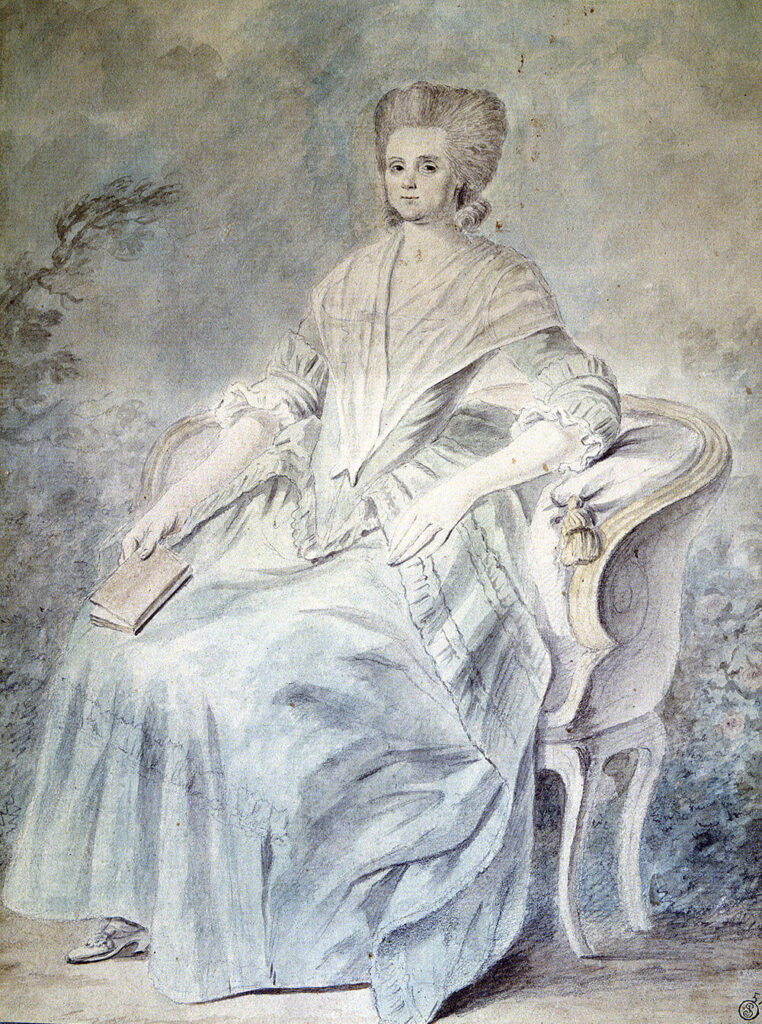
Olympe de Gouges was born into a bourgeois family in Montauban, in the south of France, in 1748. Her father was a butcher, but Olympe claimed for much of her life that her real father was the Marquis de Pompignan, her mother’s lover, who was a playwright and poet. This assertion has not been proven or disclaimed by historians, so may very well be true. Her education was fairly basic, but she was intelligent and well-spoken. At the age of 16 she reluctantly married the much older Louis-Yves Aubry; although he died only two years later, shortly after the birth of their son Pierre Aubry, her experience of marriage formed many of her later views. She wrote later that “Marriage is the tomb of trust and love”.
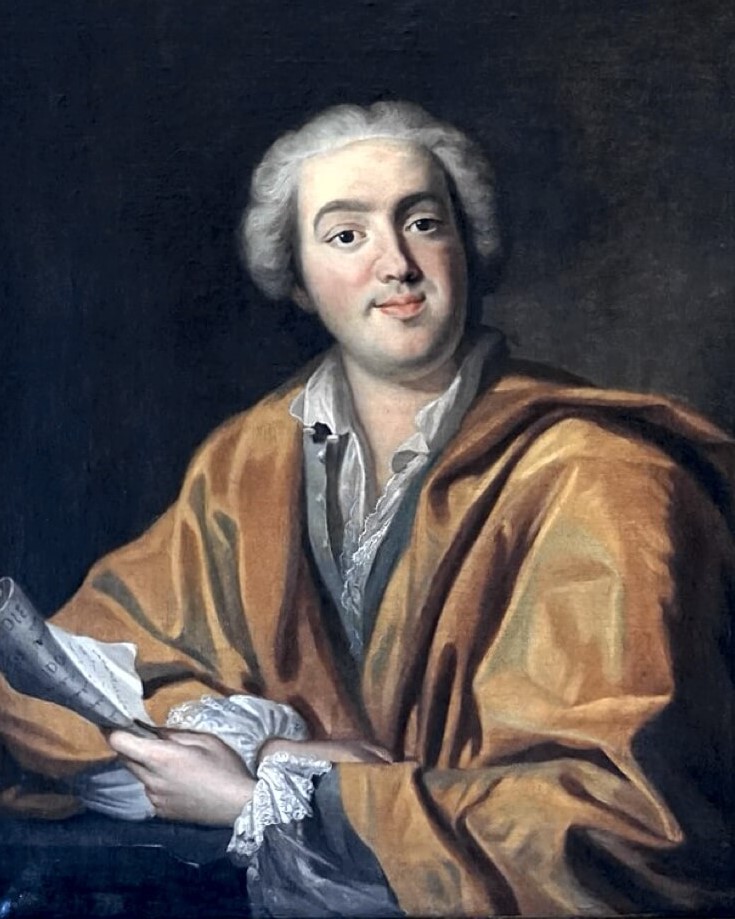
Revelling in her widow status, she vowed never to marry again and moved to Paris with her son. Here she integrated herself into Parisian literary society – with a new identity. Taking her mother’s middle name, Olympe, adding ‘de’ and changing Gouze to Gouges, her aristocratic sounding name opened more doors for her in Paris. Soon she was busy with her burgeoning career as a playwright, writing plays about social issues such as slavery, which unfortunately were not commercial successes.
Life for women
So what was it like to be a woman at this time? All women if they were single were under the guardianship of their father or brothers, and if they were married, under their husband’s rule. Divorce was forbidden, and women had no control over their person or their property, nor could they notarize documents or contest wills. Decisions over children were made by the father.
“Women, at least as things now stand, children, foreigners, in short those who contribute nothing to the public establishment, should have no direct influence on the government”. Abbe Emmanuel-Joseph Sieyes, author of the Declaration of the Rights of Man, July 1789.
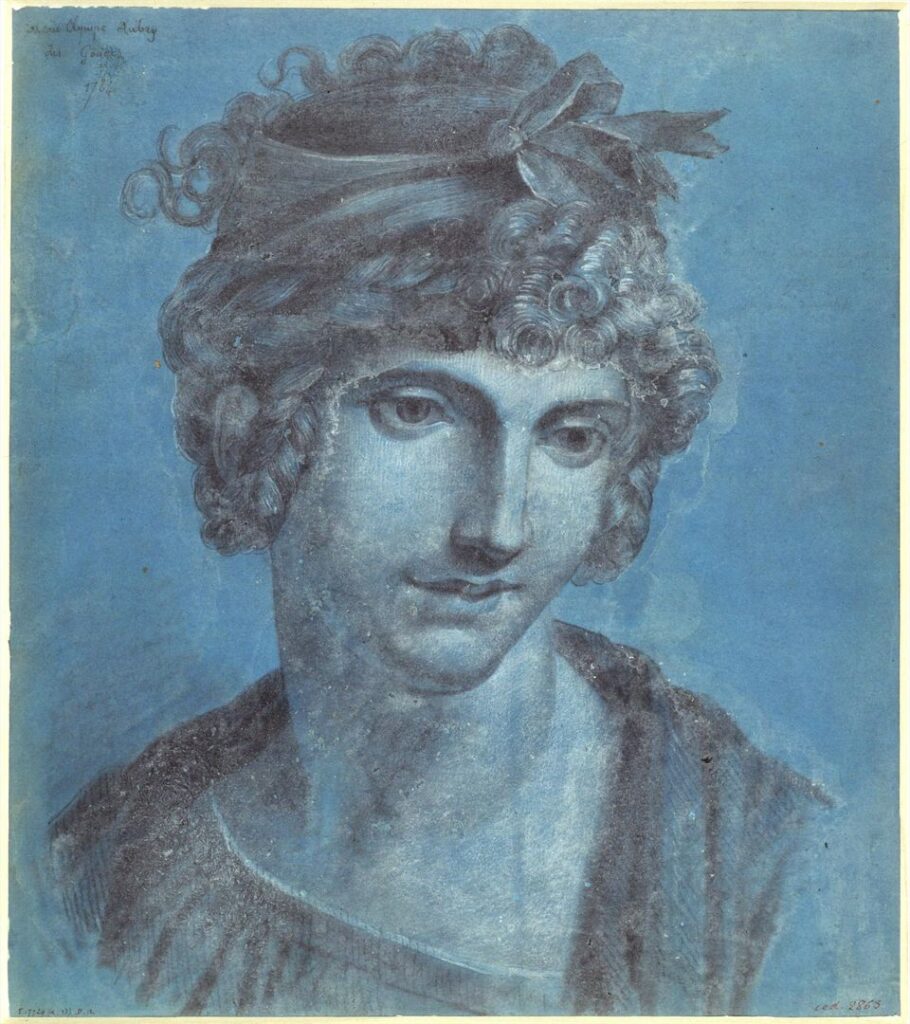
For Olympe de Gouges, this was not acceptable. In a letter to Louis XVI, titled The Cry of the Wise One, by a Woman, she wrote “I have long been an observer of men; I have had to admit that most of them have desiccated hearts, abject souls, are weak spirited and embody the spirit of evil”.
Becoming an activist
In the early years of the revolution Olympe published a number of pamphlets, setting out her proposals for social security, care for the elderly, institutions for homeless children, hostels for the unemployed, and the introduction of a jury system. She was also concerned for the rights of unmarried mothers and illegitimate children and sought the establishment of maternity hospitals.
When the National Assembly was created in 1789, Olympe joyfully sat and watched and commented on what she thought was the birth of democracy in France. She was a familiar figure in the galleries and at the podium and her pamphlets often covered the walls of the city of Paris. A Parisian, stopping to look at a proclamation on the wall in 1790, stated “Oh, it’s just Olympe de Gouges”.
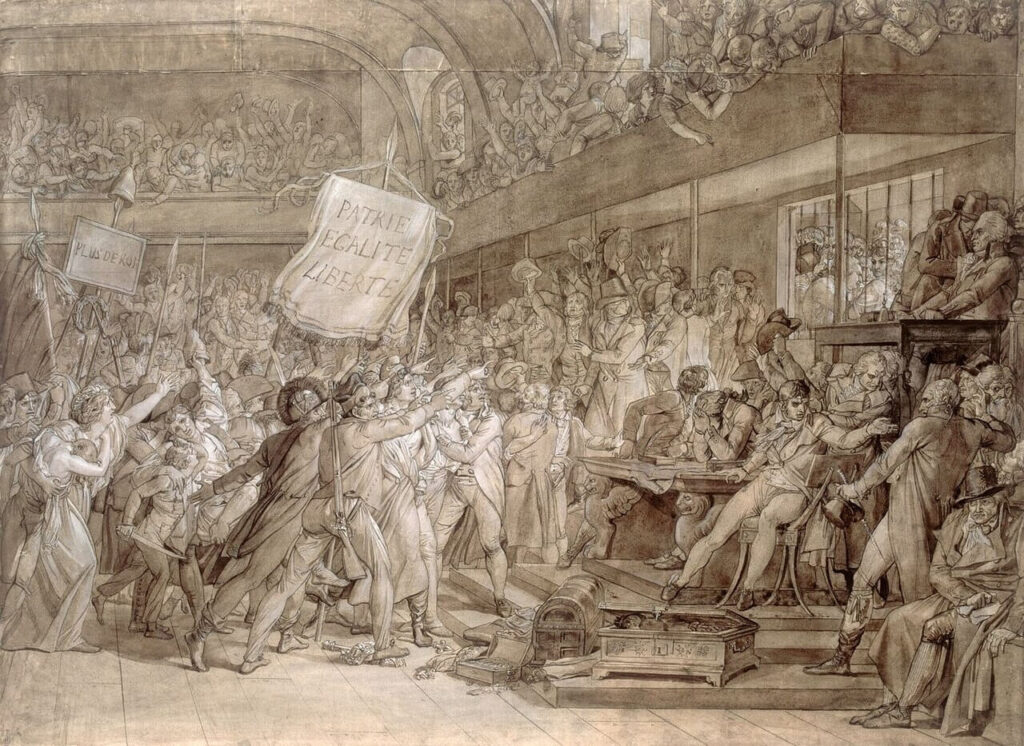
But in September 1791, the female activists were bitterly disappointed. The Constitution was finally ratified, and its preamble used the 1789 Declaration of the Rights of Man and Citizens: “Men are born and remain free and equal in rights”. Women were conspicuous for their complete absence from the national document.
A week or so later, on 14 September, Olympe de Gouges sent the National Assembly her own response – Declaration of the Rights of Woman and Female Citizens (Déclaration des droits de la femme et de la citoyenne), in which she asked: “Man, are you capable of being just? A woman is asking: at least you will allow her that right. Tell me? What gave you the sovereign right to oppress my sex?”
The document was addressed to Queen Marie Antoinette, “Madame, only one placed by chance in an eminent position can promote the Rights of Woman and hasten its success”.
She continued:
Tell me, what gives you sovereign empire to oppress my sex? Your strength? Your talents? Observe the Creator in his wisdom; survey in all her grandeur that nature with whom you seem to want to be in harmony, and give me, if you dare, an example of this tyrannical empire. Go back to animals, consult the elements, study plants, finally glance at all the modifications of organic matter, and surrender to the evidence when I offer you the means; search, probe, and distinguish, if you can, the sexes in the administration of nature. Everywhere you will find them mingled; everywhere they cooperate in harmonious togetherness in this immortal masterpiece.
And finished:
Woman, wake up; the tocsin (alarm bell) of reason is resounding throughout the universe: acknowledge your rights”.
Words are weapons
History does not record the response of the men in the National Assembly as the Declaration was read, but one can imagine – guffaws, incredulity, perhaps a little outrage. Olympe’s words were considered extremely radical for the time. Feminism was merely a vague idea, it would not even be given a name until 1837 by French philosopher Charles Fourier.
Olympe de Gouges was a feminist, but she was also outspoken in her political views; it was this which would ultimately lead to her death. She was associated with the Girondins, the moderate wing of the government, who were overthrown by the extremist and bloodthirsty Jacobins who took control under the leadership of Maximilien Robespierre. The country was soon consumed by the ‘Reign of Terror’ which saw thousands of supposed royalists and political opponents sent to the guillotine.
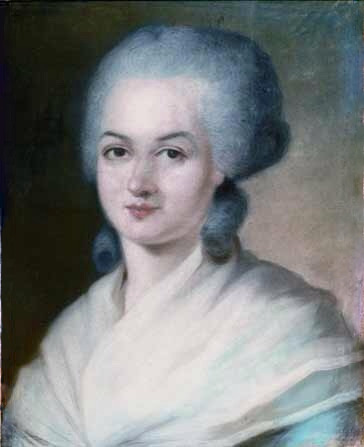
For Olympe, her words were her weapons.
To Robespierre:
I am going to list your characteristics: your breath is poisoning the pure air that we breathe; your vacillating eyelid expresses, despite yourself, all the ignominy of your soul and each hair on your head carries a crime. 5 November 1792. I have planned it all, I know that my death is inevitable; but, when an ignominious death threatens all good citizens, how glorious and beautiful it is for a noble soul to perish for her dying motherland.
The French can no longer procrastinate: the day of reckoning has arrived. Now is the time to establish a decent government whose energy comes from the strength of its laws; now is the time to put a stop to assassinations and the suffering they cause, for merely holding opposing views.
The death of Olympe de Gouges
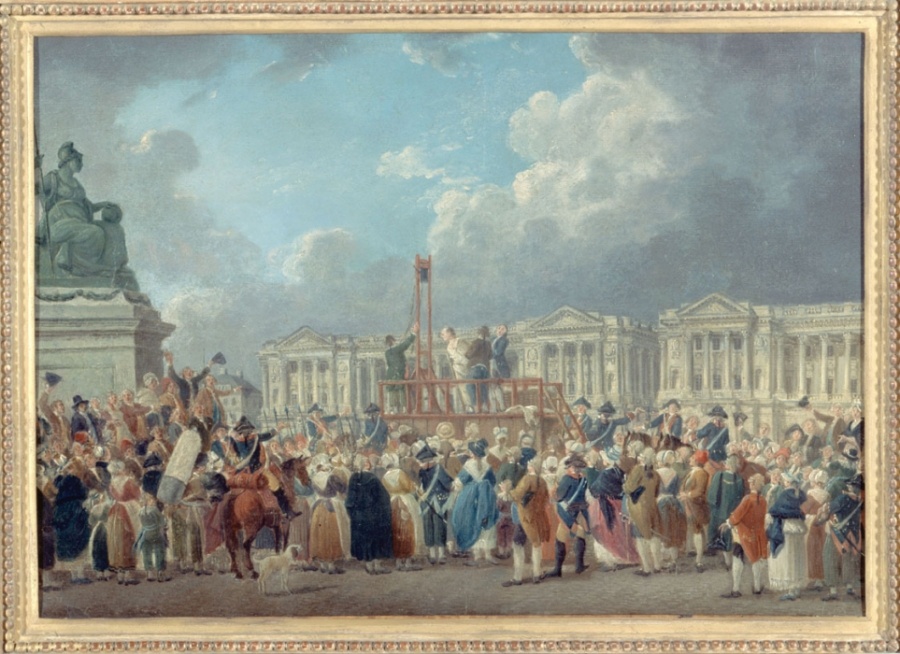
It was the last document which sealed the fate of Olympe de Gouges. Accused of treason, she was arrested the following day, and sent to the dreaded Conciergerie prison in the heart of Paris. On 3 November, 1793, after a ridiculously speedy trial in which she was denied legal representation, her hair was roughly shorn and she held her head high as she travelled to the Place de la Révolution in the back of an open cart, the same journey Marie Antoinette had taken two weeks earlier. She mounted the scaffold and was guillotined. Legend tells us she cried “Children of the Motherland, avenge my death!”. The papers and plays found in her home were burnt, and all her possessions became property of the state.
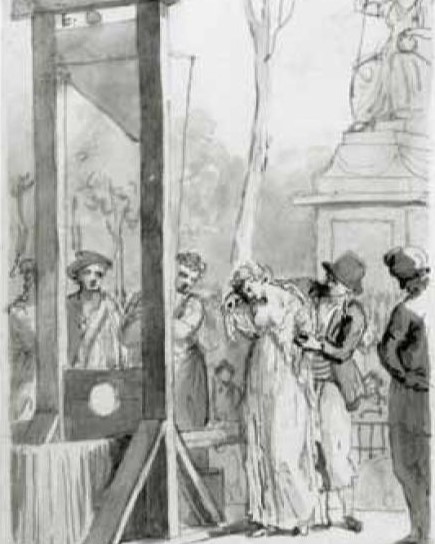
The government were unrepentant: “She wished to be a politician and it seems that the law has punished this conspirator for forgetting the virtues appropriate to her sex”.
Read this post on Bastille Day
No revolution for women
What followed was a blitz on women – all female clubs and societies were banned and gatherings of women in public were forbidden. The prosecutor of Paris, Pierre-Gaspard Chaumette, put women in their place: “Remember the shameless Olympe de Gouges, who was the first to set up women’s clubs, who abandoned the cares of her household to involve herself in the republic, and whose head fell under the avenging blade of the laws?”
In May 1795, the Convention voted to exclude women from its meetings; in future they would be allowed to watch only if they were accompanied by a man carrying a citizen’s card. Three days later the Convention placed all Parisian women under a form of house arrest. “All women are to return to their domiciles until otherwise ordered. Those found on the streets in groups of more than five one hour after the posting of this order will be dispersed by force and then held under arrest until public tranquillity is restored in Paris”.
There were some laws passed by the Convention which benefited women. Male and female children should inherit equally, the age of majority for women (and men) was lowered to 21, divorce was legalised, and women were granted some voice in the administration of shared property. Unfortunately, even these limited gains were taken away 10 years later with the Napoleonic Codes.
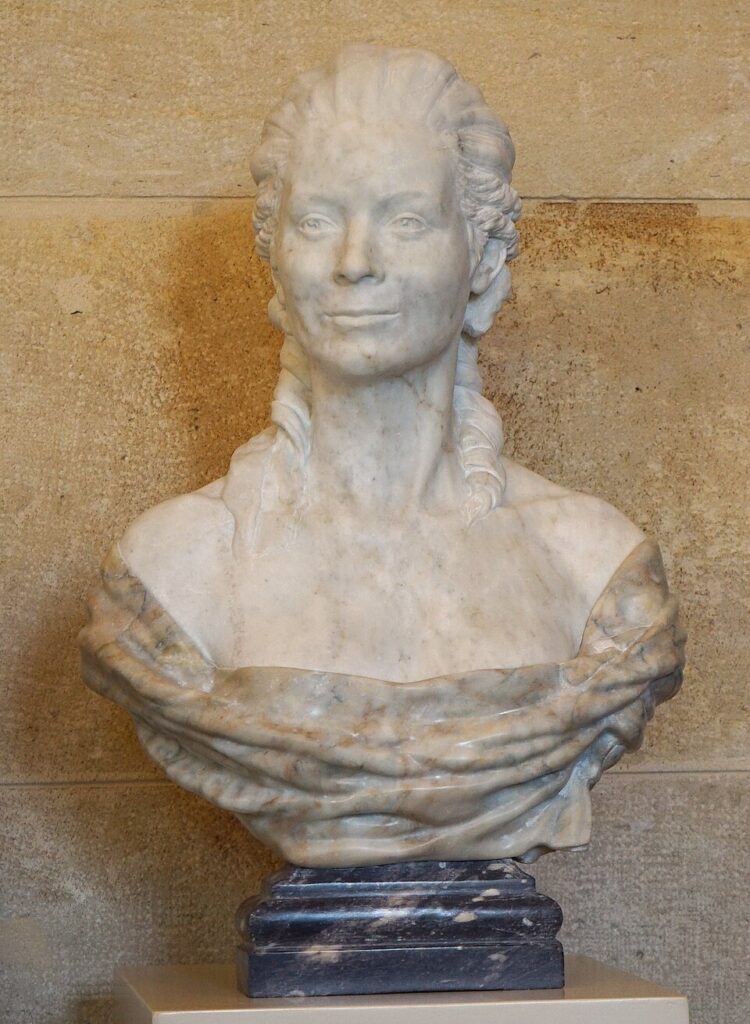
In 2016, Olympe de Gouges was finally recognised by the French government for her contribution to society, and a bust in her likeness was ceremoniously installed in the Palais Bourbon, which houses the Assemblée Nationale. Fittingly, she was the first woman to receive this honour.
Related post: The women march on Versailles
Declaration of the Rights of Woman and the Female Citizen
PREAMBLE
Mothers, daughters, sisters [and] representatives of the nation demand to be constituted into a national assembly. Believing that ignorance, omission, or scorn for the rights of woman are the only causes of public misfortunes and of the corruption of governments, [the women] have resolved to set forth in a solemn declaration the natural, inalienable, and sacred rights of woman in order that this declaration, constantly exposed before all the members of the society, will ceaselessly remind them of their rights and duties; in order that the authoritative acts of women and the authoritative acts of men may be at any moment compared with and respectful of the purpose of all political institutions; and in order that citizens’ demands, henceforth based on simple and incontestable principles, will always support the constitution, good morals, and the happiness of all.
Consequently, the sex that is as superior in beauty as it is in courage during the suffering of maternity recognized and declares in the presence and under the auspices of the Supreme Being, the following Rights of Woman and of Female Citizens.
I
Woman is born free and remains the equal of man in rights. Social distinctions can only be founded on a common utility.
II
The purpose of all political organisations must be the protection of the natural and imprescriptible rights of Woman and Man: these rights are liberty, property, security and above all the right to resist oppression.
III
The principle of sovereignty is vested primarily in the Nation, which is but the union of Woman and Man: no body, no individual, can exercise authority that does not explicitly emanate from it.
IV
Liberty and justice exist to render unto others what is theirs; therefore the only limit to the exercise of the natural rights of woman is the perpetual tyranny that man opposes to it: these limits must be reformed by the laws of nature and reason.
V
The laws of nature and reason forbid all acts that are harmful to society: anything not forbidden by these wise and divine laws must be allowed and no one can be constrained to do what the laws do not demand.
VI
The law must embody the will of the majority; all Female and Male citizens must contribute personally, or through their representatives, to its development; it must be the same for one and all: all Female and all Male citizens, being equal in law, must be equally entitled to all public honours, positions and employment according to their capacities and with no other distinctions than those based solely on talent and virtue.
VII
No woman may be exempt; she must be accused, arrested and imprisoned according to the law. Women, like men, will obey this rigorous law.
VIII
The law must only establish punishments that are strictly necessary, and none can be punished other than by a law established and promulgated prior to the offence, and legally applied to women.
IX
The law will rigorously pursue any woman found to be guilty.
X
None must be disquieted for their opinions however fundamental: woman is entitled to mount the scaffold; she must be equally entitled to mount the rostra so long as her manifestos do not disturb the public order according to the law.
XI
The free expression of thoughts and opinions is one of the most precious rights of woman given that this liberty ensures the legitimacy of fathers and their children.
XII
Guaranteeing the rights of woman and the female citizen will be a great benefit: this guarantee must be instituted for the good of all and not just to benefit those individuals to whom it is entrusted.
XIII
Women and men are to contribute equally to the upkeep of the forces of law and order and to the costs of administration: woman shares all the labour, all the hard tasks; she should therefore have an equal share of positions, employment, responsibilities, honours and professions.
XIV
Female and male citizens have a right to decide for themselves, or through their representatives, the necessity of public contribution. Female citizens can only subscribe to it if they are allowed an equal share not only of wealth but also of public administration and in determining the amount, assessment, collection and duration of the tax.
XV
The collective of women, joined to that of men for the purposes of taxation, has the right to demand of any public agent an account of its administration.
XVI
No society can have a constitution if rights are not guaranteed, or the separation of powers not determined; the constitution is worthless if the majority that make up the Nation has not participated in its redaction.
XVII
Property belongs to both sexes, united or separated; for each it is an inviolable and sacred right; no one can be deprived of a true natural heritage unless a general necessity, legally verified, obviously requires it and on condition of a fair indemnity agreed in advance.
POSTSCRIPT
Woman, wake up; the tocsin of reason is being heard throughout the whole universe; discover your rights. The powerful empire of nature is no longer surrounded by prejudice, fanaticism, superstition, and lies. The flame of truth has dispersed all the clouds of folly and usurpation. Enslaved man has multiplied his strength and needs recourse to yours to break his chains. Having become free, he has become unjust to his companion. Oh, women, women! When will you cease to be blind? What advantage have you received from the Revolution? A more pronounced scorn, a more marked disdain. In the centuries of corruption you ruled only over the weakness of men. The reclamation of your patrimony, based on the wise decrees of nature – what have you to dread from such a fine undertaking? The bon mot of the legislator of the marriage of Cana? Do you fear that our French legislators, correctors of that morality, long ensnared by political practices now out of date, will only say again to you: women, what is there in common between you and us? Everything, you will have to answer. If they persist in their weakness in putting this non sequitur in contradiction to their principles, courageously oppose the force of reason to the empty pretensions of superiority; unite yourselves beneath the standards of philosophy; deploy all the energy of your character, and you will soon see these haughty men, not groveling at your feet as servile adorers, but proud to share with you the treasures of the Supreme Being. Regardless of what barriers confront you, it is in your power to free yourselves; you have only to want to. Let us pass not to the shocking tableau of what you have been in society; and since national education is in question at this moment, let us see whether our wise legislators will think judiciously about the education of women.
(follow this link to read the rest of the postscript)
Sources
Jane Abray, “Feminism in the French Revolution”, The American Historical Review, Vol. 80, No. 1, 1975
Hannelore Schrodert, “The Declaration of human and civil rights for women”, History of European Ideas, Vol I, 1989
All images are in the public domain and taken from wikicommons